
Scent as Sensory Anastylosis: The Potentino Project
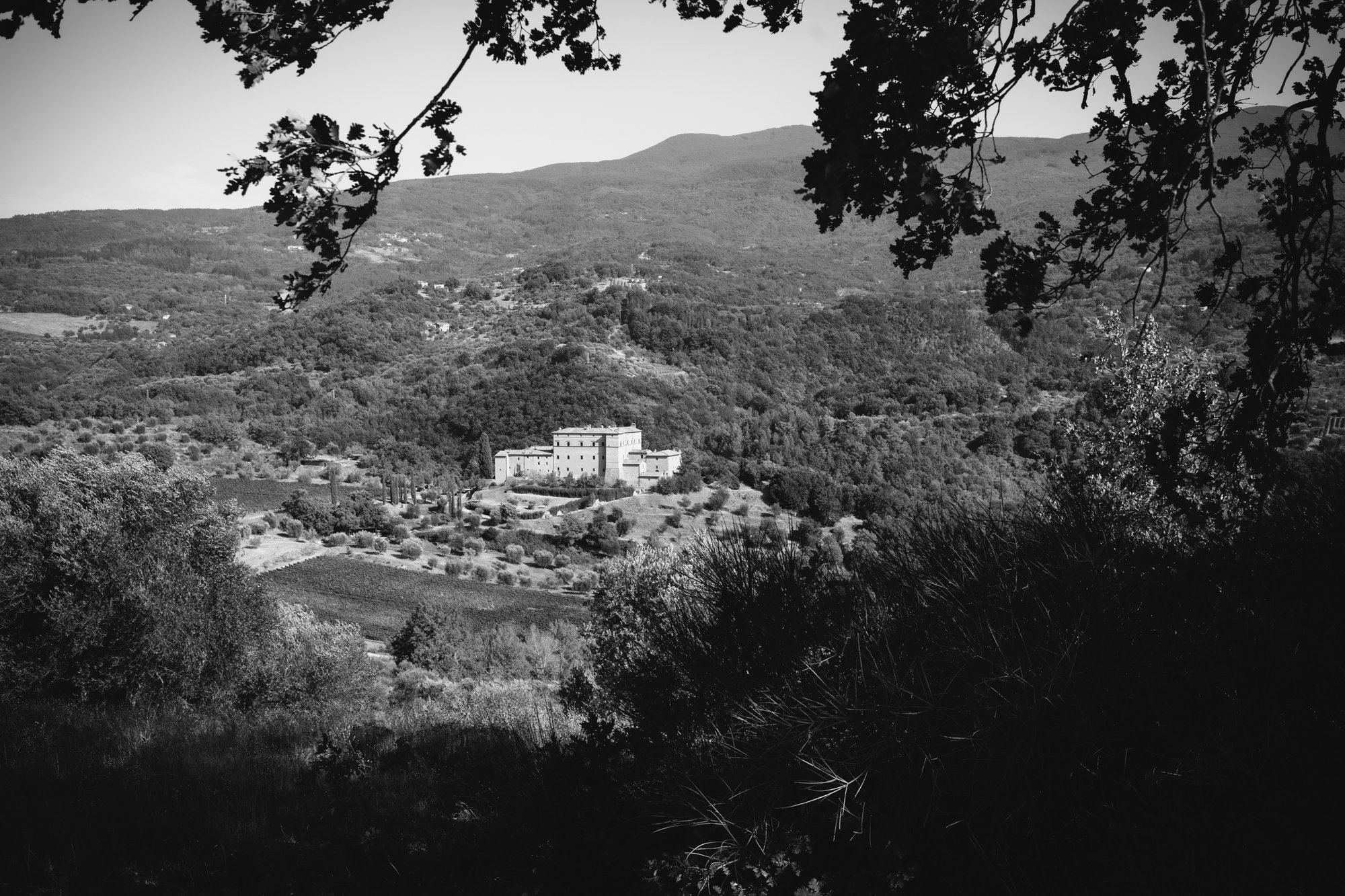
At Castello di Potentino in the Monte Amiata valley of southern Tuscany, a rare ecological continuity endures. Here, poet-scholar and olfactory artist Susan Barbour and perfumer Michael Nordstrand begin a new phase of collaborative research into how past inhabitants of this landscape perceived and composed their sensory world.

Unlike much of the Italian countryside, the land surrounding the castle has never undergone industrialised agriculture, preserving a biodiverse ecosystem shaped by Etruscan, Roman, and medieval life. This layered terrain provides the foundation for a project that approaches scent as both historical evidence and living material.
Bringing together olfactory field research, historical perfumery scholarship, and archaeological inquiry, the collaboration explores scent as a bridge between environmental history and the ritual, domestic, and horticultural practices of earlier communities. Susan’s previous residencies at Potentino produced a mapped scent walk and an olfactory field guide documenting the valley’s contemporary chemosignals—its aromatic plants, resins, woods, soils, and subtle human traces. In this next phase, ongoing fieldwork intersects with Michael’s research into medieval medicinal plants, his reconstruction of ancient perfumes, and his public scholarship on humanity’s enduring relationship with aromatic botanicals.
A further dimension of the project draws upon archaeological research into the ruins of a Franciscan monastery and Roman garden in the valley, contributing material evidence to this unfolding exploration of Potentino’s lived sensory histories.
The team works through three interwoven approaches:
ecological observation of Potentino’s extant biodiversity;
close study of textual and archaeological sources on Mediterranean perfumery;
and experimental reconstruction through historically grounded fragrance formulation.
Rather than treating perfumery solely as aesthetic expression, the project embraces what the team calls sensory anastylosis—the reassembly of ecological and historical fragments into materially plausible experiential forms. Through collaborative fieldwork and experimental composition, these reconstructed scents invite contemporary audiences to encounter the valley’s sensory past directly, drawing new generations into relationship with deeper human and ecological continuities.
About the Collaborators

Susan Barbour
Susan Barbour is a poet-scholar, visual and olfactory artist, and independent perfumer whose work spans literature, sensory art, and the study of smell as a form of knowledge.
She holds an M.A. from Johns Hopkins University and a D.Phil. in English Literature from University of Oxford. Alongside her creative and scholarly publications, she earned the Level 4 Diploma from the Wine & Spirit Education Trust, an experience that refined her sensory practice and ultimately led her toward perfumery as both interpretive and compositional art. She reflects on this evolution in her TEDxRoma talk, I Smell Human.
During an artist residency—extended unexpectedly by the COVID-19 pandemic—at Castello di Potentino, Susan deepened her practice of scent walking, documenting the valley’s human and ecological olfactory life. As founder of the independent scent house AMIATA, she creates scent-poems that translate biodiverse landscapes into wearable form, inviting renewed attention, embodiment, and reciprocity between humans and place.

Michael Nordstrand
Michael Nordstrand is the founder of Mythologist Studio™ and a distinctive voice in contemporary perfumery, known for balancing technical precision with emotional depth through a cross-disciplinary approach uniting art, history, and science.
He trained in perfume creation and cosmetic sciences at Givaudan, ISIPCA, and The Grasse Institute of Perfumery, and holds certification in medicinal plants from Cornell University, where he focused on botanicals popularized during the Middle Ages.
A self-described “method perfumer,” Michael immerses himself fully in the historical and conceptual world of each project. His work has been recognized with the Art and Olfaction Awards (2025) and the British Society of Perfumers Award (2024). His practice spans fragrance creation for major houses such as Tom Ford and Jo Malone, as well as institutional collaborations with the Getty and the Metropolitan Museum of Art, where his research and educational initiatives examine humanity’s enduring relationship with aromatic plants.